How to Teach Equations of Parallel and Perpendicular Lines
When you teach parallel and perpendicular lines, it's easy to fall into a routine: same slope, negative reciprocal, write the equation, move on.
But do your students actually understand why those rules work, or are they just memorizing them for the next quiz?
We used to teach this topic that way, too. But we found that students have a much better understanding when they can see where the rules come from. We'd rather spend a little more time helping them discover the relationships between the slopes than spend the next few weeks reminding them which rule to use.
That's the approach we take in Unit 3, Lesson 2 of the Geometry Sidekick curriculum. Students start by exploring how transformations affect the slopes of lines. Then they use what they've discovered to write equations of parallel and perpendicular lines.
Let students discover the slope rules
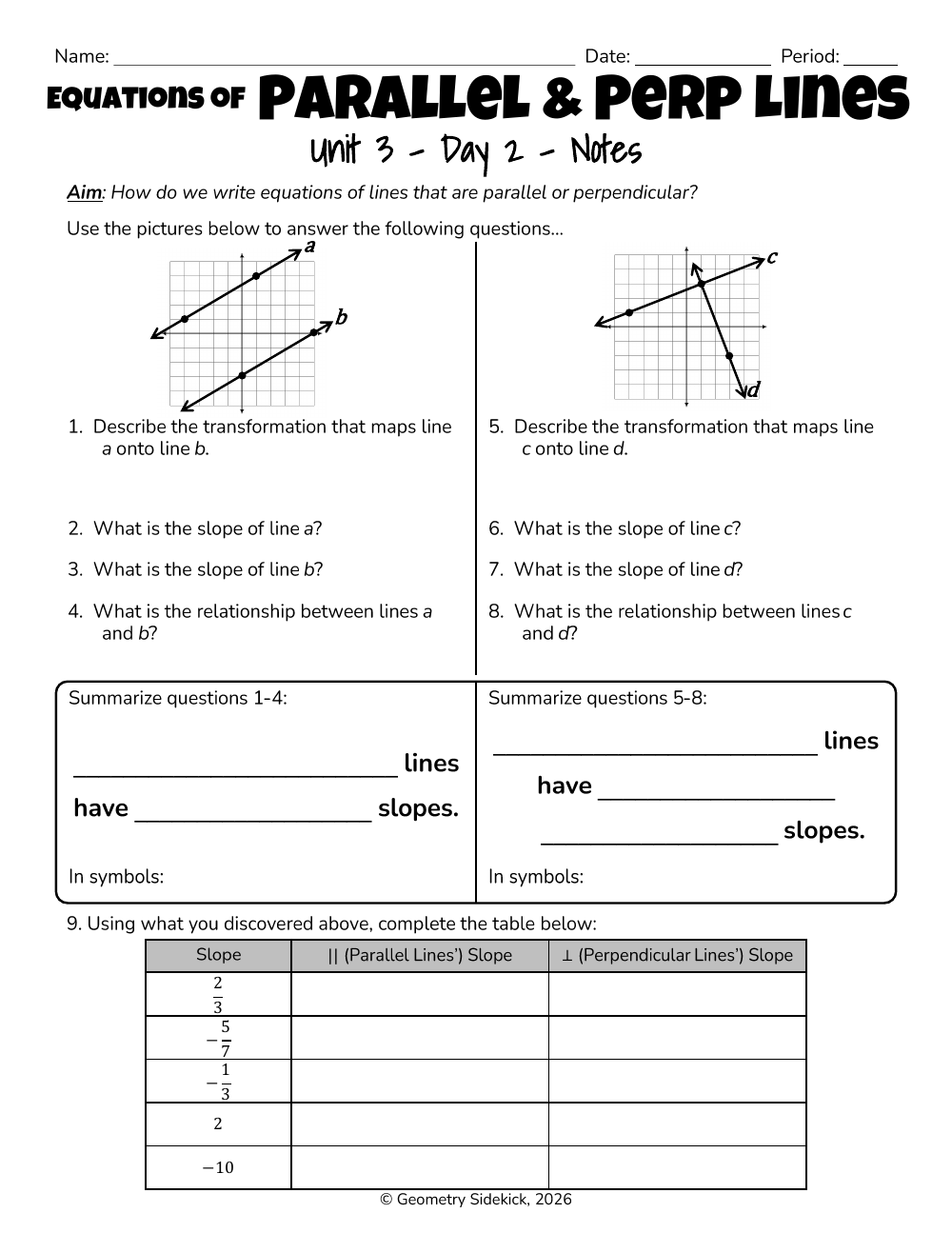
The guided notes use transformations to help students see how the slopes of lines are related. Students compare a line with its translation and then look at what happens to a line when it's rotated 90 degrees. By looking at the slopes before and after each transformation, they can recognize the patterns for the slopes of parallel and perpendicular lines.
Once they've identified those patterns, students put their observations into words and use them to establish the slope rules.
The lesson at a glance
- Course: High School Geometry - Unit 3, Day 2
- Common Core Standards:
- HSG-CO.A.1: know precise definitions of angle, circle, perpendicular line, parallel line and line segment, based on the undefined notions of point, line, distance along a line and distance around a circular arc
- HSG-GPE.B.5: prove the slope criteria for parallel and perpendicular lines and use them to solve geometric problems (e.g., find the equation of a line parallel or perpendicular to a given line that passes through a given point)
- You need:
- Guided notes (2 pages)
- Practice activity (2 pages)
- SWBAT:
- write equations of lines that are parallel or perpendicular to another line, given a point and a line in slope-intercept or point-slope form.
- write equations of lines that are parallel or perpendicular to another line, given a graph with a line and a point.
Here are 3 habits that make it stick for your students:
Once students understand the slope relationships, they can start using them to write equations. But there are a few places where students tend to get mixed up.
- Make sure they know which slope to use.
Students sometimes confuse the slope rules for parallel and perpendicular lines.
- Parallel lines have the same slope.
- Perpendicular lines have negative reciprocal slopes.
It seems simple, but students can easily switch the two rules when they're working through a problem. The examples in the guided notes give them a chance to practice identifying the correct relationship before they start writing equations.
- Break the negative reciprocal into two steps.
When students find the negative reciprocal of a slope, they sometimes change the sign but forget to flip the fraction. Other times, they flip the fraction but forget to change the sign.
We can break it into two separate steps:
- Flip the fraction.
- Change the sign.
- Don't skip the problems where the line is given as a graph.
Students may be comfortable finding the slope when they're given an equation, but things can get trickier when they have to work from a graph.
Before they can write the new equation, have them find the slope of the line shown. Then they can use that slope to find the slope of a parallel or perpendicular line.
Another thing to emphasize is that the new line needs to pass through the given point, not one of the points on the original line.
Unit 3, Day 2: Equations of Parallel and Perpendicular Lines
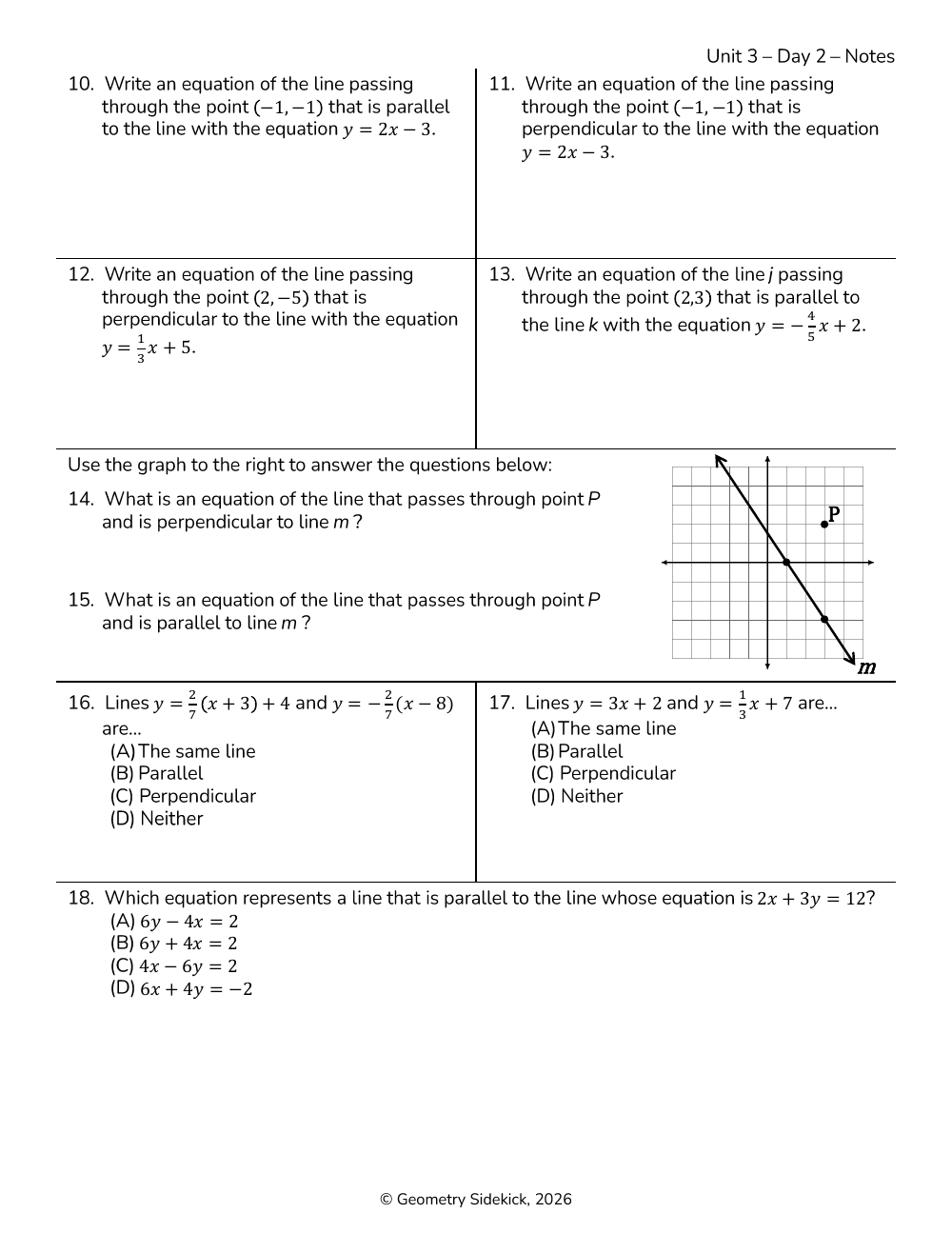
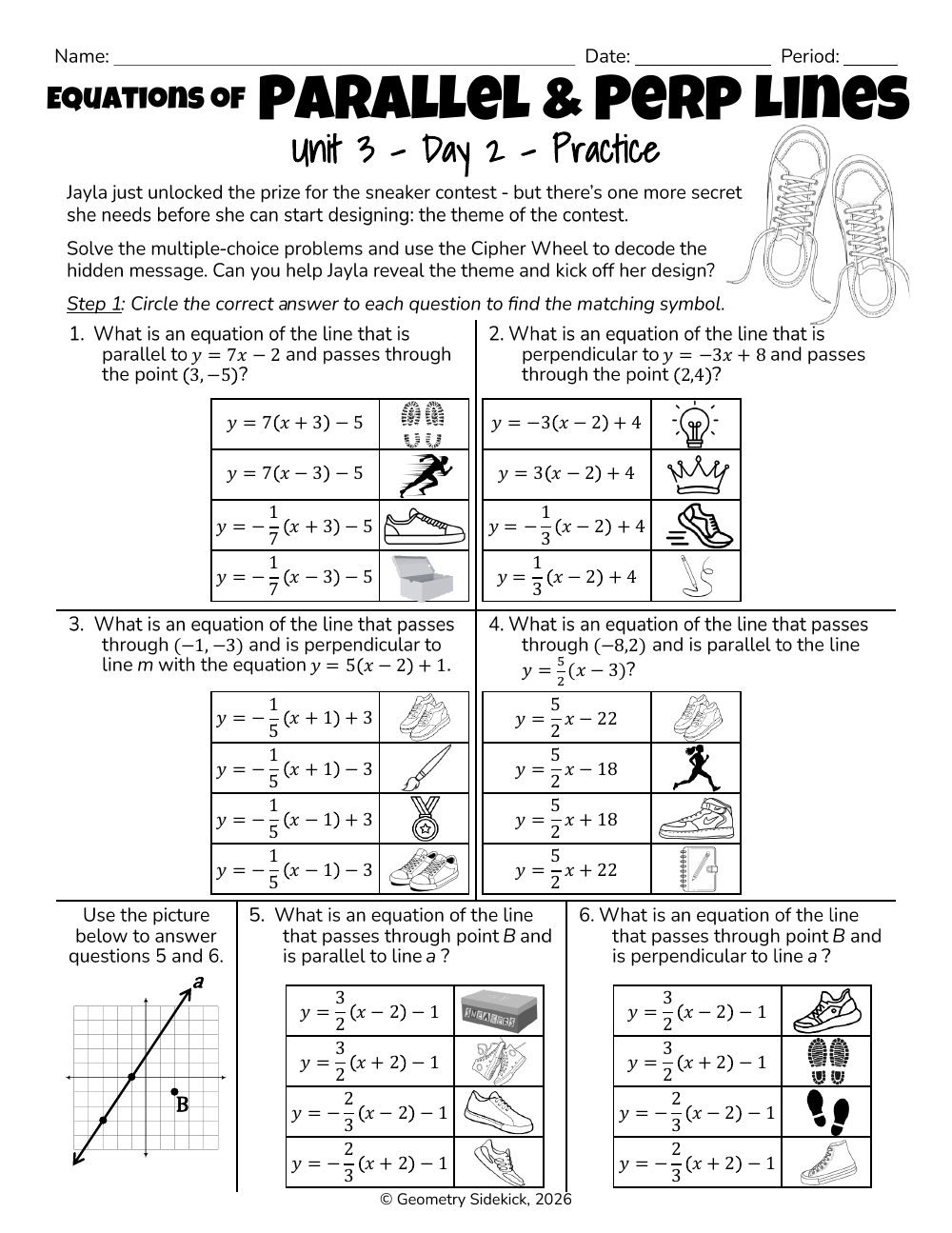
This lesson includes guided notes and a cipher wheel practice activity.
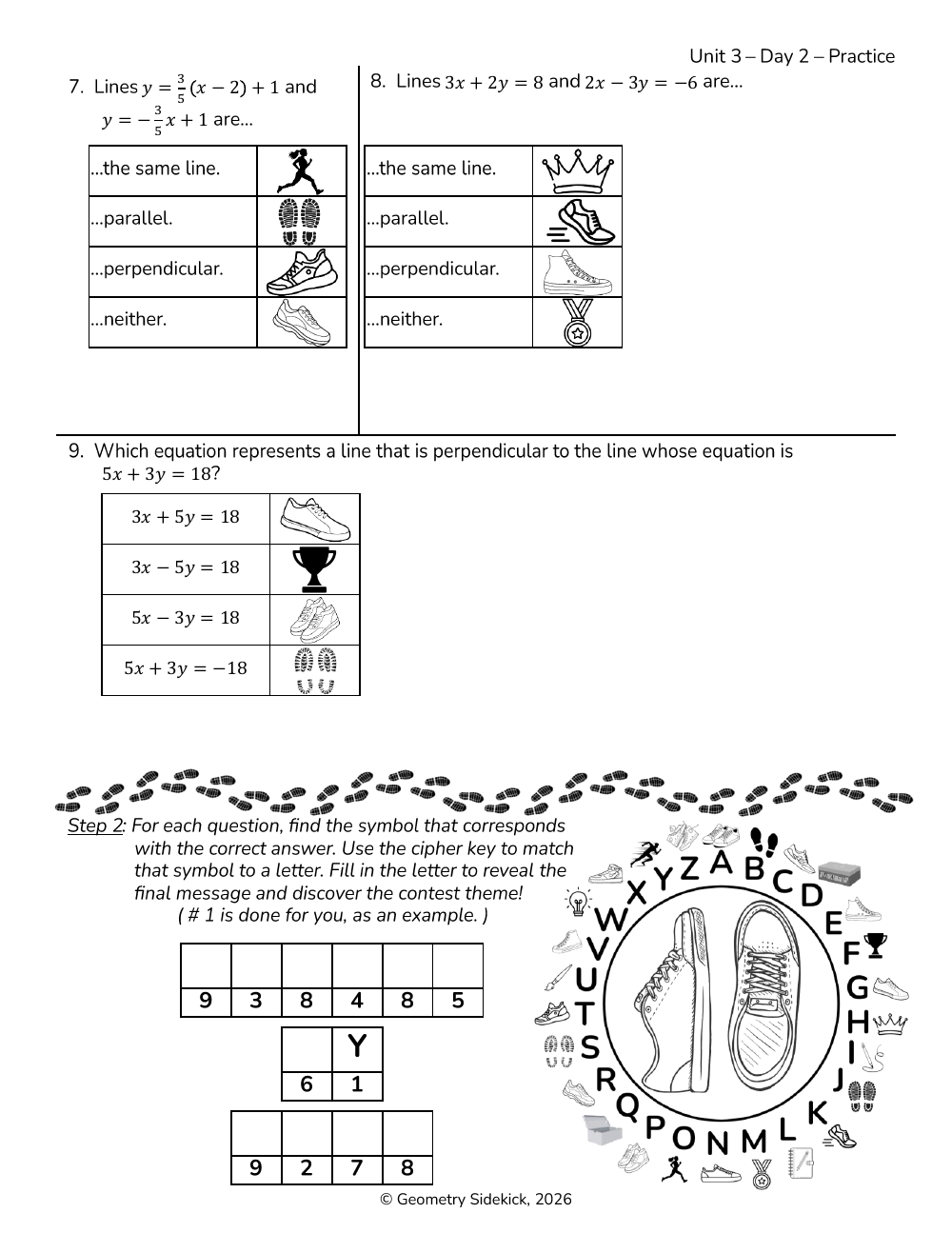
Like every practice activity in the Geometry Sidekick curriculum, the cipher wheel is self-checking. Every answer choice has a symbol next to it. Students circle the correct answer, find that symbol on the cipher wheel, and write down the letter it goes with.
Once they've answered all nine questions, the letters spell out the theme of Jayla's sneaker contest. If they've answered everything correctly, the message makes sense. If not, they'll know they need to go back and check their answers.
Students can discover on their own whether they're correct. No waiting for you to check their work, and no answer key needed just to see if they got it right.
The files
We are teachers, your email is safe with us. Unsubscribe anytime.
This lesson is from our Unit 3 (Parallel and Perpendicular Lines)
- 3.01 Review of Linear Equations
- 3.02 Equations of Parallel and Perpendicular Lines
- 3.03 Coordinate Geometry: Proving Right Triangles
- 3.04 Equations of Perpendicular Bisectors
- 3.05 Transversal Angle Names
- 3.06 Transversal Angle Relationships
- 3.07 Mixed Angle Practice
- 3.08 Proving Lines are Parallel
See every unit in the membership
THE MEMBERSHIP
Want every Geometry lesson, ready to teach?
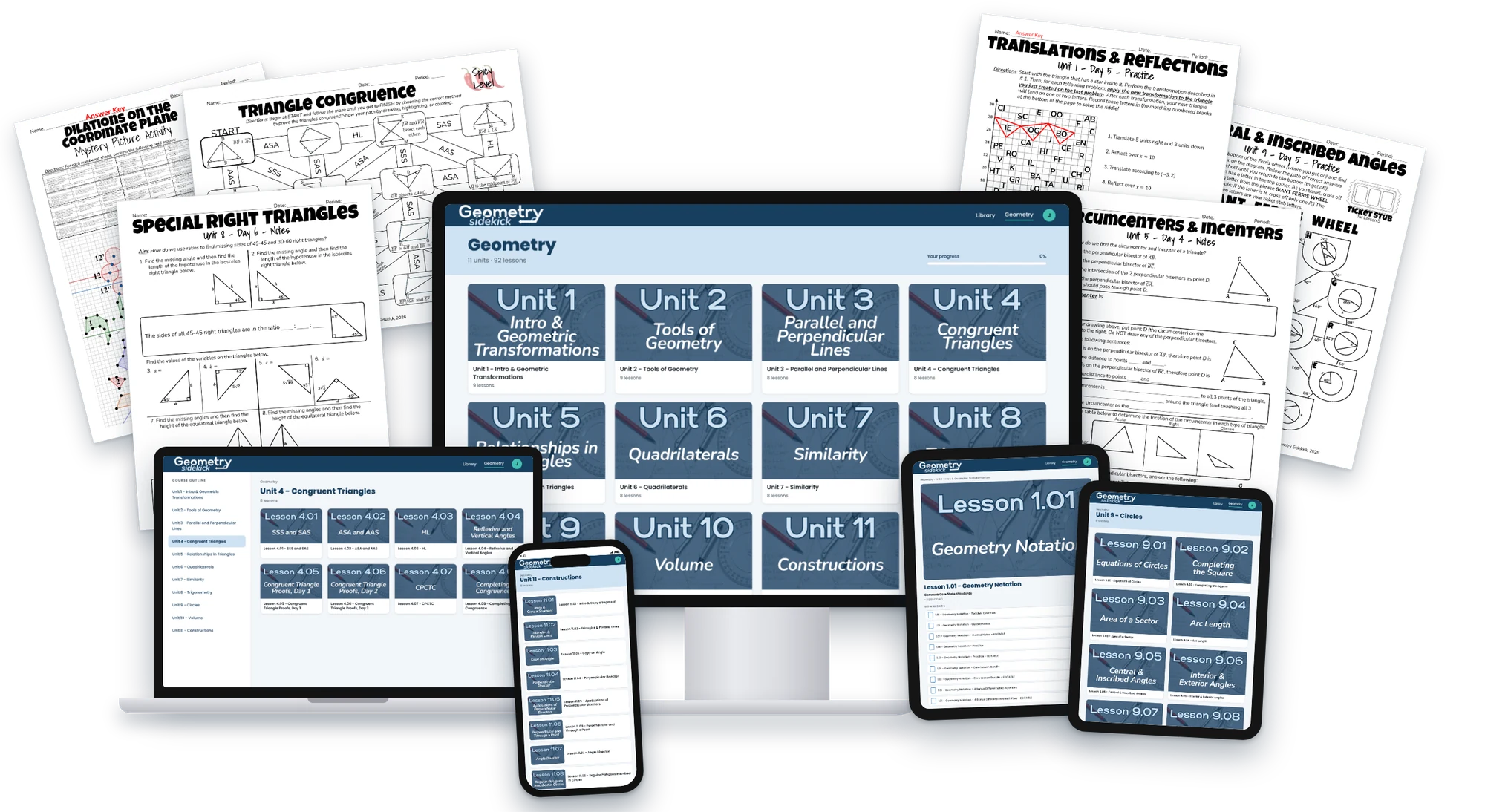
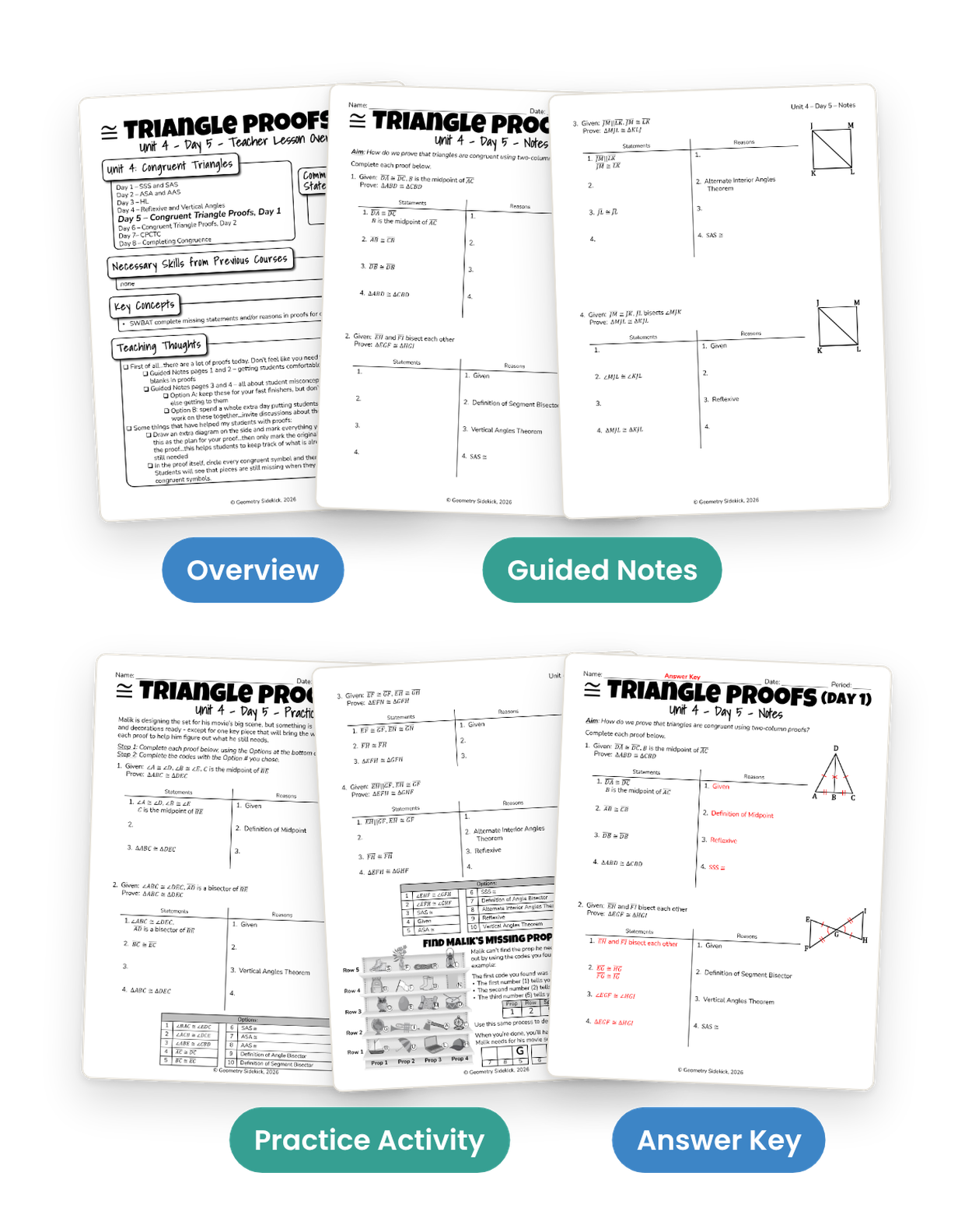
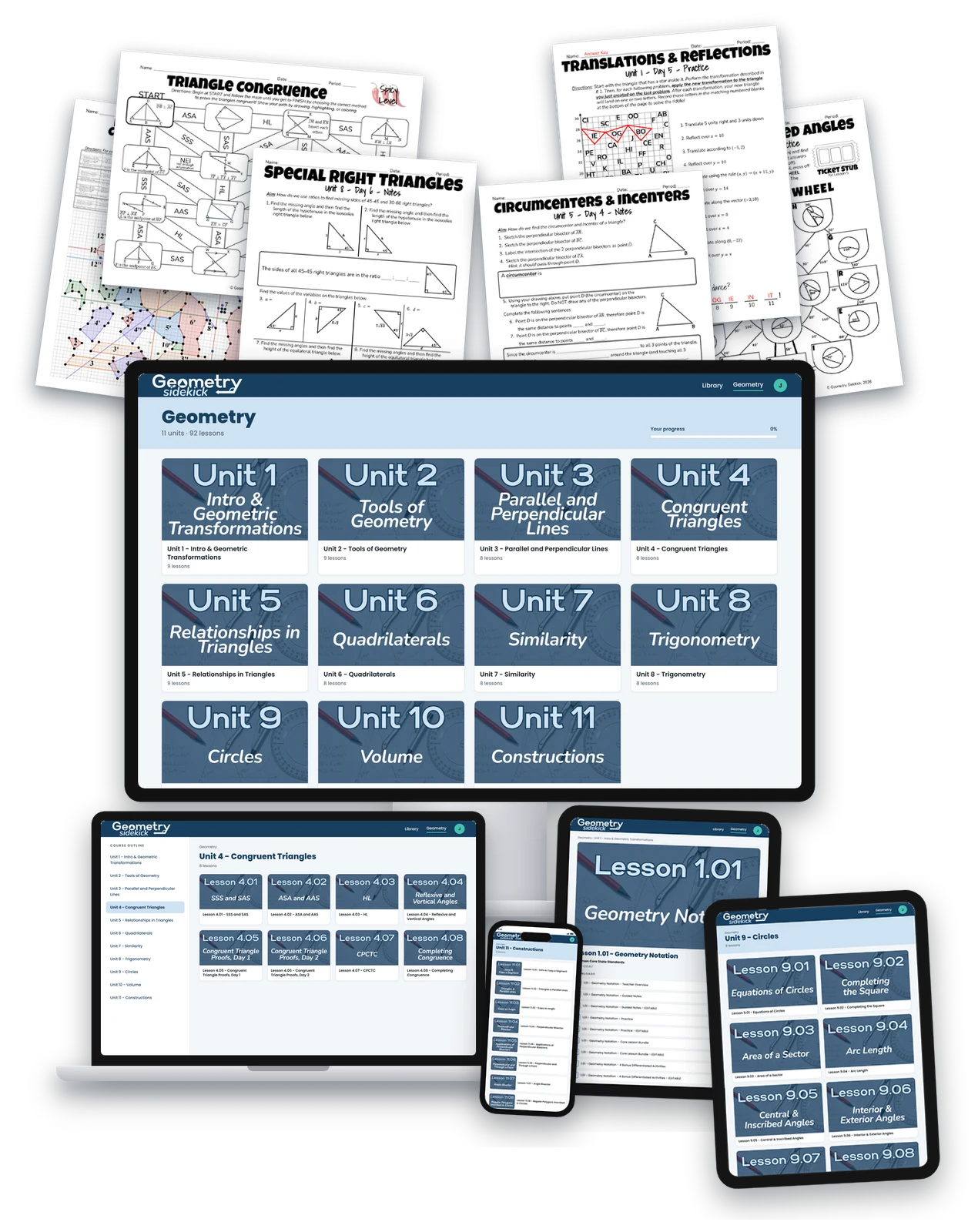
All 11 units with 92 total lessons, each with a teacher overview, guided notes, a practice activity and a fully worked answer key. Available as a PDF or an editable PowerPoint. Members also get access to bonus differentiated activities for selected lessons across the curriculum. Open the lesson you need tomorrow, print it, teach it.
Join Membership