How to Teach Geometry Notation: Points, Lines, Segments and Rays
Have you ever been grading your Geometry students' work and found a problem they got wrong, not because they couldn't do it, but because they didn't know which part of the diagram it was asking about?
The problem asked for segment AB, but they identified line AB or ray AB. Or maybe just two points labeled A and B, because to them, AB was just two letters.
We see this happen throughout the year. Students don't know how to correctly read and interpret geometry notation, and they're getting problems wrong that they should be getting right.
That's why Geometry Notation is Unit 1, Lesson 1 in the Geometry Sidekick curriculum. It's one of those foundational skills that shows up in every lesson of every unit. If students are shaky on it from the beginning, they're going to run into trouble throughout the rest of Geometry.
So we're giving you this lesson for free. Use it to help your students build a strong foundation and get off to a good start in your Geometry classroom.
The problem with the textbook version
Open almost any textbook to this lesson, and you'll find simple diagrams. Students are asked to identify and/or name a segment, a line, or a ray. That's a good place to start, but it's not the skill they'll actually need throughout their Geometry course.
What they really need to do is look at a complicated diagram and figure out exactly which part of the picture a question is referring to.
That's what we do in this lesson. Instead of giving students a bunch of isolated diagrams, we give them one complicated picture with multiple questions. They have to figure out which part of the diagram the question is asking about when it says line AB versus segment AB.
And we don't stop at identification. We also address common misconceptions by asking students to analyze the diagrams and explain their thinking.
For example, instead of simply telling students that you need two points to name a line, we ask them why naming a line B is ambiguous when point B lies on two different lines.
It's a small difference in how we teach the concept, but it gets students thinking about why the notation matters instead of just memorizing the rules.
The lesson at a glance
- Course: High School Geometry - Unit 1, Day 1
- Common Core Standard: HSG-CO.A.1: know precise definitions of angle, circle, perpendicular line, parallel line and line segment, based on the undefined notions of point, line, distance along a line and distance around a circular arc
- You need:
- Guided notes (2 pages)
- Practice activity (1 page)
- Highlighter or a colored pencil/pen
- SWBAT:
- define and understand essential vocabulary related to Geometry.
- use correct geometric notation to represent points, lines, segments, and rays.
- interpret geometric notation and accurately identify the corresponding parts of a diagram.
Here are 3 habits that make it stick for your students:
- Circle the symbol.
Every time a problem names something, circle the symbol above the letters and write the word beside it. See the arrow? Circle it and write ray.
Do it out loud, in front of the class, every single time. And yes, it feels slow.
But eventually, students start to realize that the symbol matters just as much as the letters.
- Explain the rays' names precisely.
The first letter is the endpoint. The second letter tells you the direction.
Say it that way, and ray BD and ray DB stop looking identical.
- Start with the vocabulary they already know.
Ask students where two walls and the ceiling intersect. Everyone points to the corner.
They've understood the word intersect for years. They just haven't necessarily connected it to what they're seeing in a Geometry diagram.
Then draw a sun with rays extending outward. Each ray starts at the sun and continues forever in one direction. It's a simple visual that gives students something familiar to connect to when they're learning about the definition of a ray.
Unit 1, Day 1: Geometry Notation
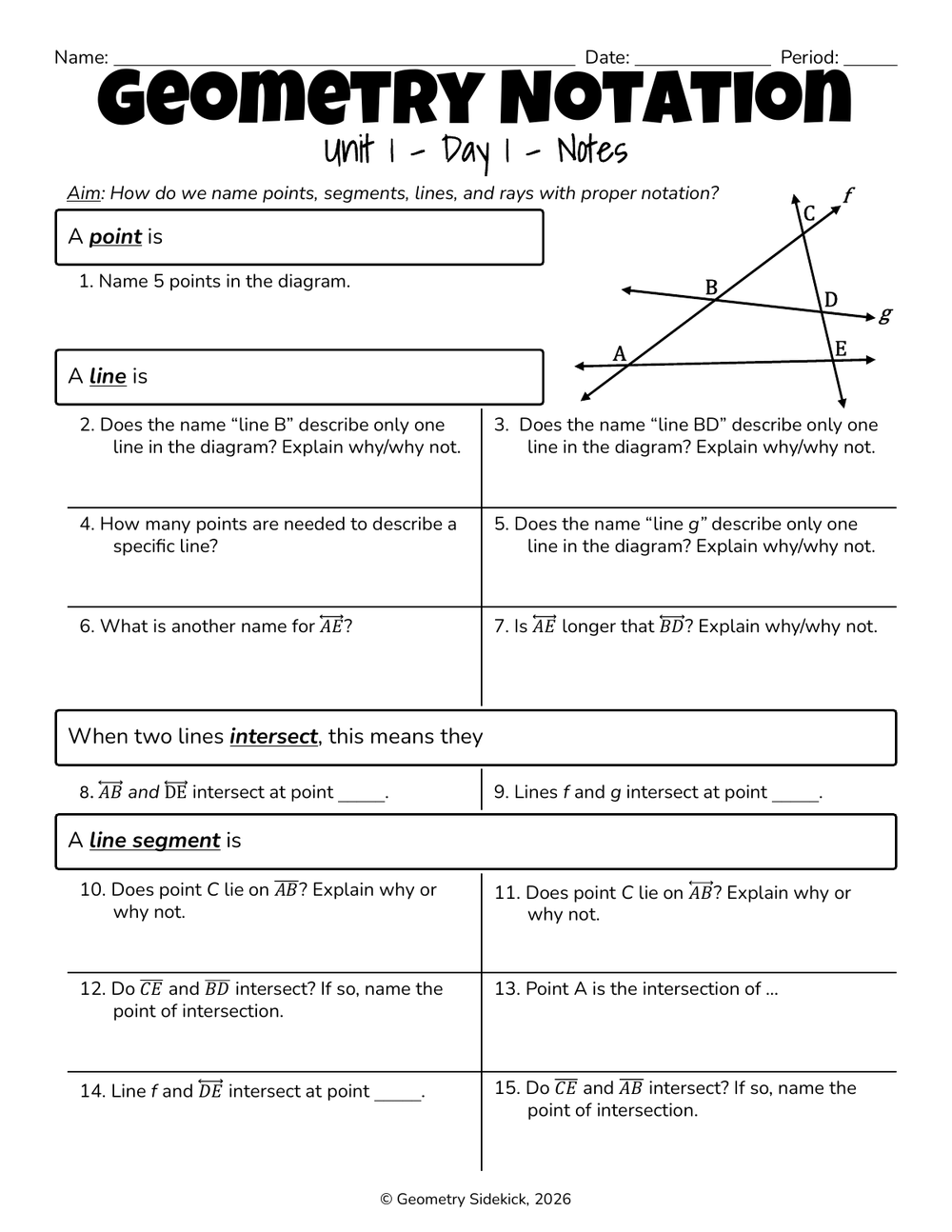
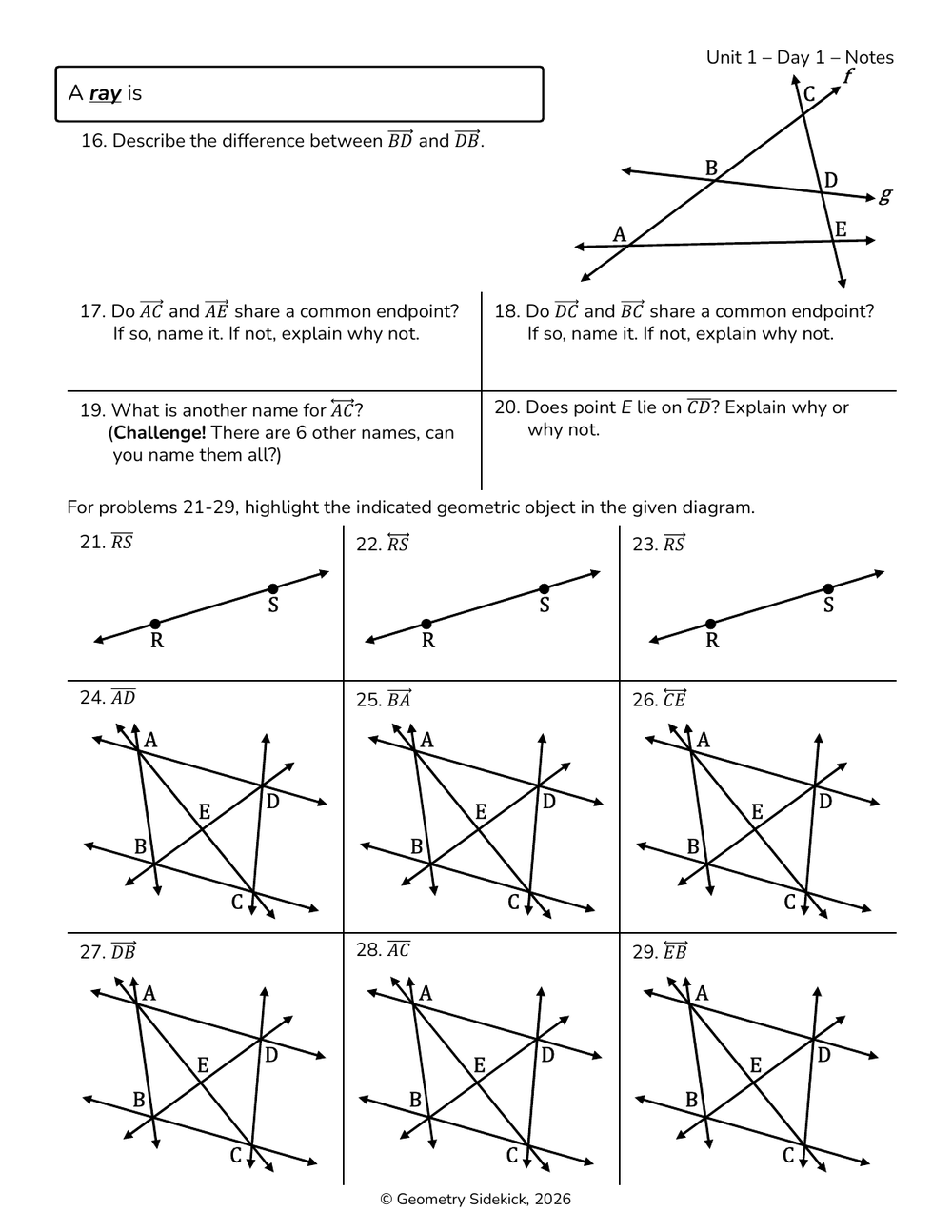
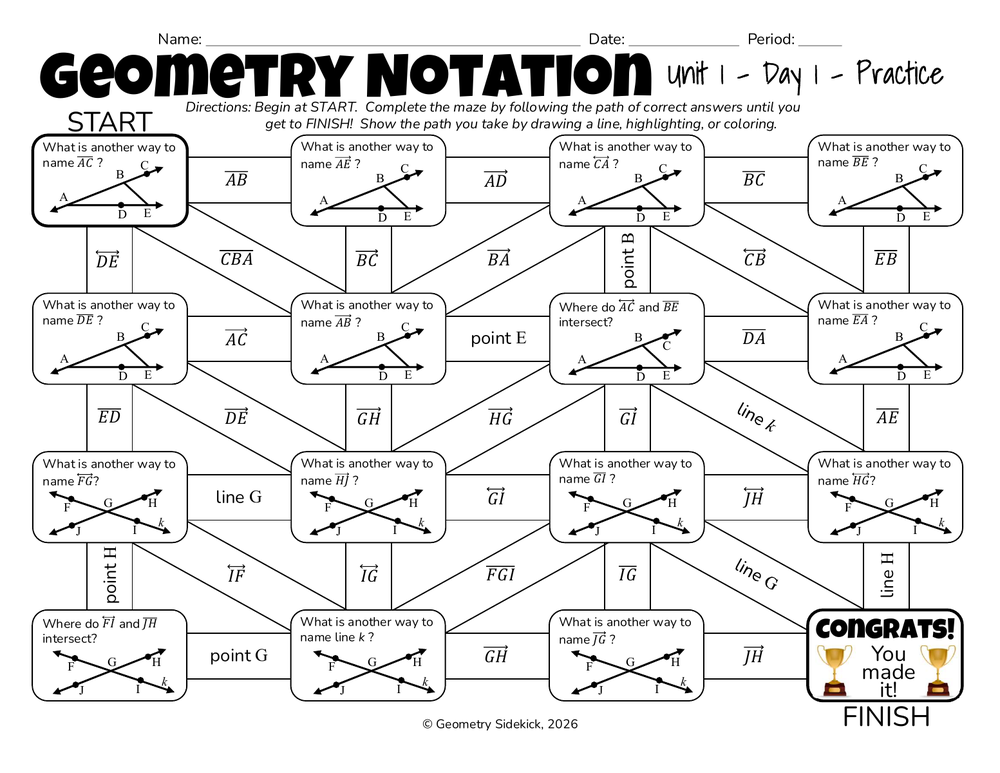
Here are the guided notes and the practice maze included in this lesson.
Like every practice activity in the Geometry Sidekick curriculum, the maze is self-checking. Wrong answers lead students down the wrong path, so eventually they discover on their own whether they're correct or not. No waiting for you to check their work, and no answer key needed just to see if they got it right.
The questions that catch the misconceptions
A few questions in the guided notes are designed to make students stop and think. The wrong answer is tempting, which is exactly the point. These are worth slowing down for.
-
Is line AE longer than line BD? (Problem 7) They look different on the page, so students say yes. But both are lines, so neither is longer.
-
Does point C lie on segment AB? On line AB? (Problems 10 and 11) Same letters, two different answers. C is past B, so it's on the line but not on the segment.
-
Do segments CE and AB intersect? (Problem 15) The lines containing the segments cross, so students say yes. But the segments stop at their endpoints and never actually meet.
-
What's the difference between ray BD and ray DB? (Problem 16) The order of the letters is the whole answer: different endpoints, different directions.
-
Does point E lie on segment CD? (Problem 20) E is on ray CD, which continues past D, not on segment CD, which stops at D. It's essentially the same idea as problem 10, just one page later. That's how you find out whether the understanding has stuck.
The files
We are teachers, your email is safe with us. Unsubscribe anytime.
This lesson is from our Unit 1 (Intro and Geometric Transformations)
- 1.01 Geometry Notation
- 1.02 Distance and Perimeter
- 1.03 Slope
- 1.04 Angle Notation
- 1.05 Translations and Reflections
- 1.06 Rotations
- 1.07 Describing Transformations
- 1.08 Congruency
- 1.09 Mapping a Figure onto Itself
See every unit in the membership
THE MEMBERSHIP
Want every Geometry lesson, ready to teach?
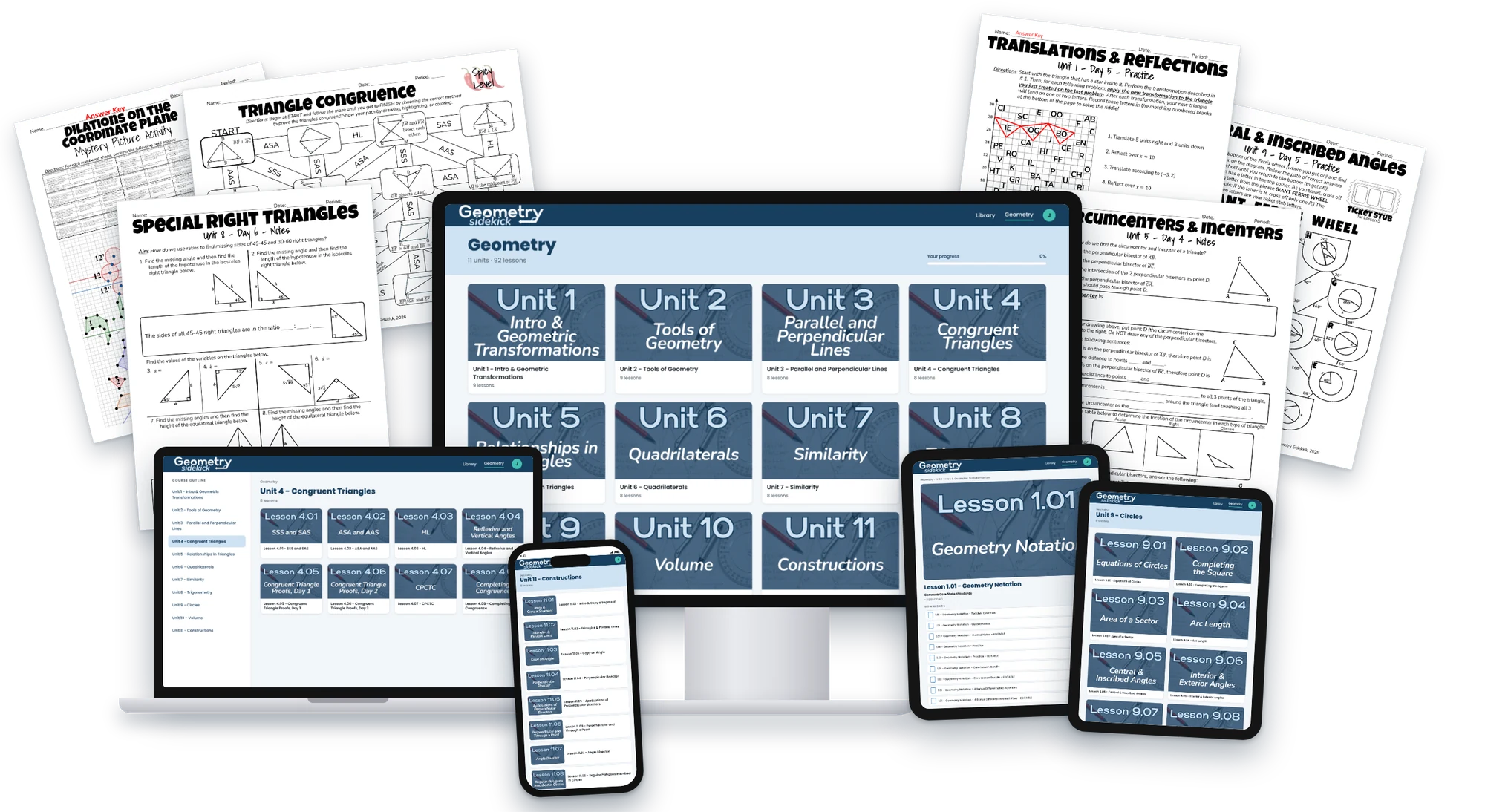
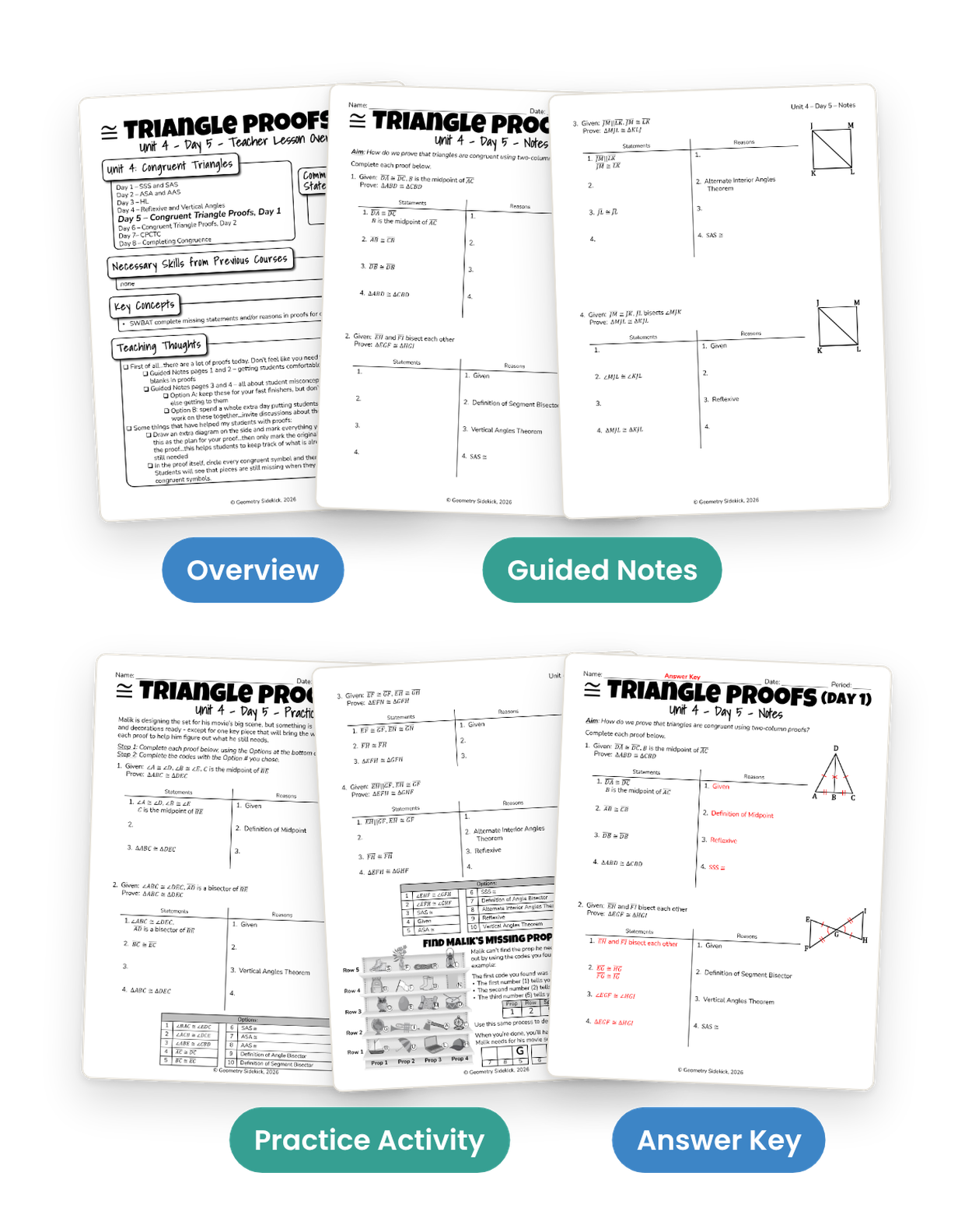
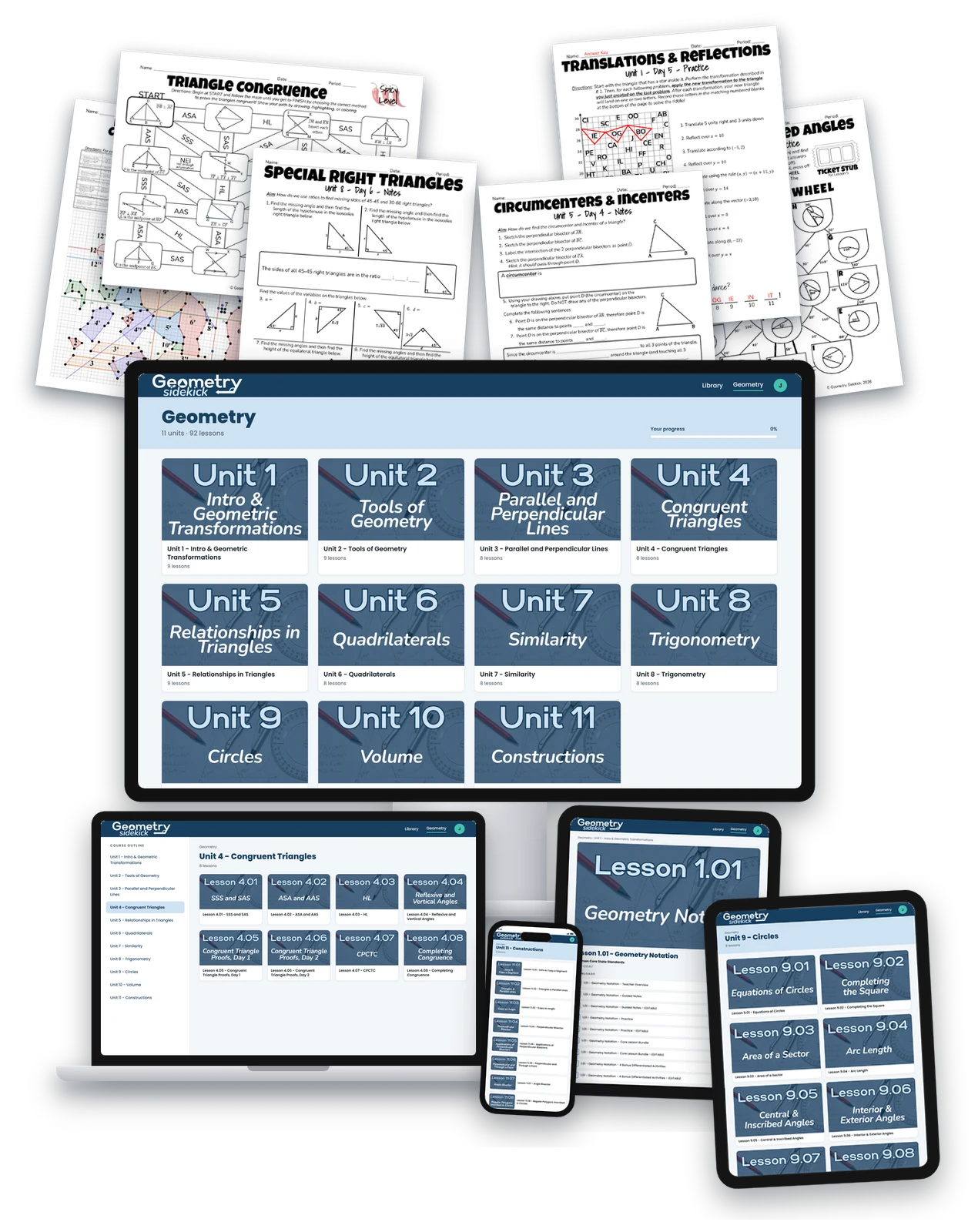
All 11 units with 92 total lessons, each with a teacher overview, guided notes, a practice activity and a fully worked answer key. Available as a PDF or an editable PowerPoint. Members also get access to bonus differentiated activities for selected lessons across the curriculum. Open the lesson you need tomorrow, print it, teach it.
Join Membership