How to Teach Medians and Centroids of Triangles
At this point in Unit 5 of the Geometry Sidekick curriculum, students have already learned about perpendicular bisectors, angle bisectors, circumcenters, and incenters. Now they're learning about medians and centroids, and they'll move on to altitudes and orthocenters in the next lesson.
The tricky part of this lesson is that students are often expected to use fractions to find the lengths of the different segments of a median. And if fractions are already something they struggle with, adding a geometry diagram and a new relationship to remember can make things even harder.
The problem with the textbook version
Open almost any Geometry textbook to this lesson, and you'll find the Centroid Theorem written in terms of fractions. The centroid is located two-thirds of the way from each vertex to the midpoint of the opposite side.
That's mathematically correct, but it can be confusing for students. Two-thirds of which segment? Is the other piece one-third of the median or one-half of the longer piece? Students end up multiplying whichever segment they see by two-thirds without really understanding which piece they're trying to find. And that's only if they even know how to multiply by two-thirds.
What they really need to understand is that the centroid divides every median into two pieces, and the longer piece is always twice as long as the shorter piece.
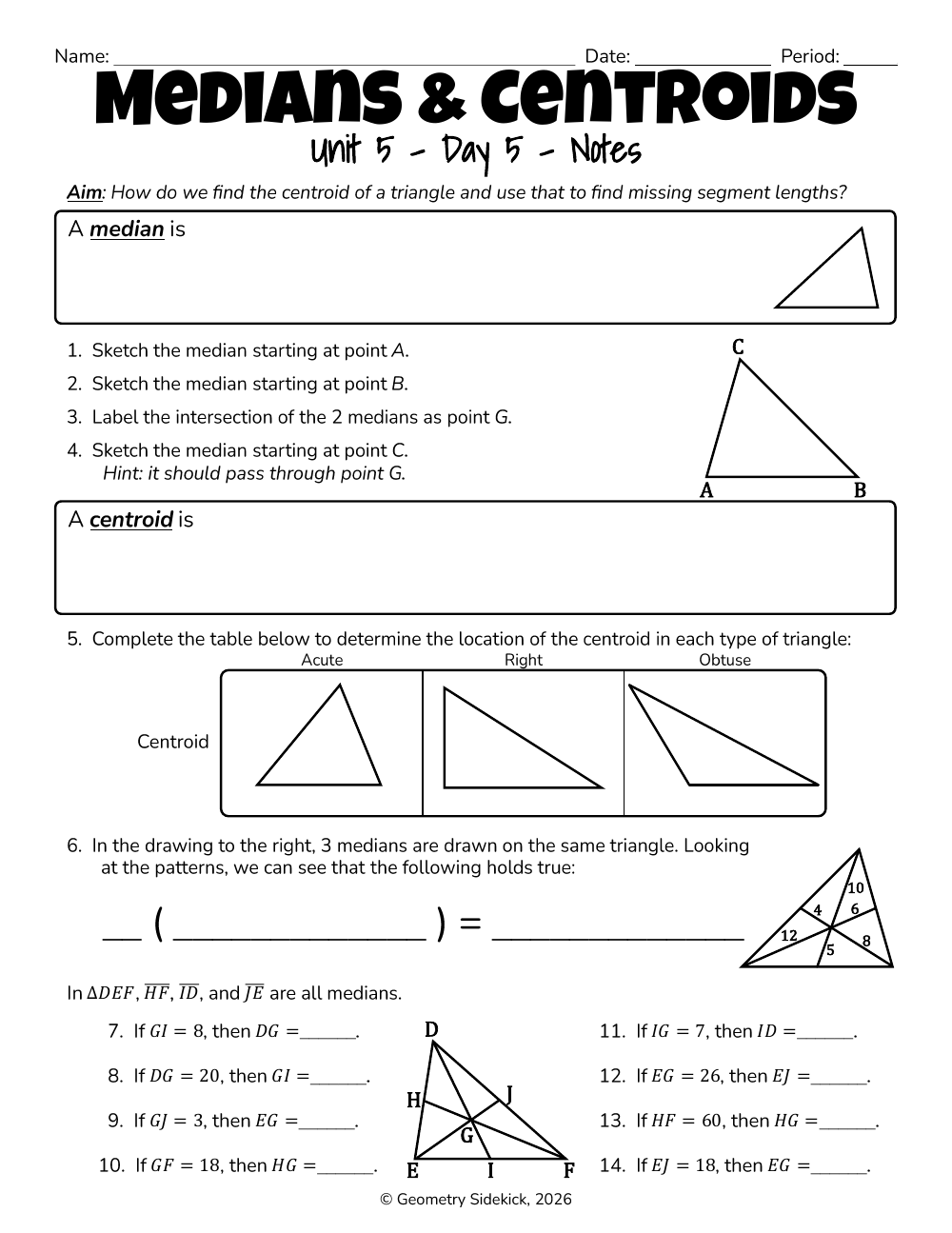
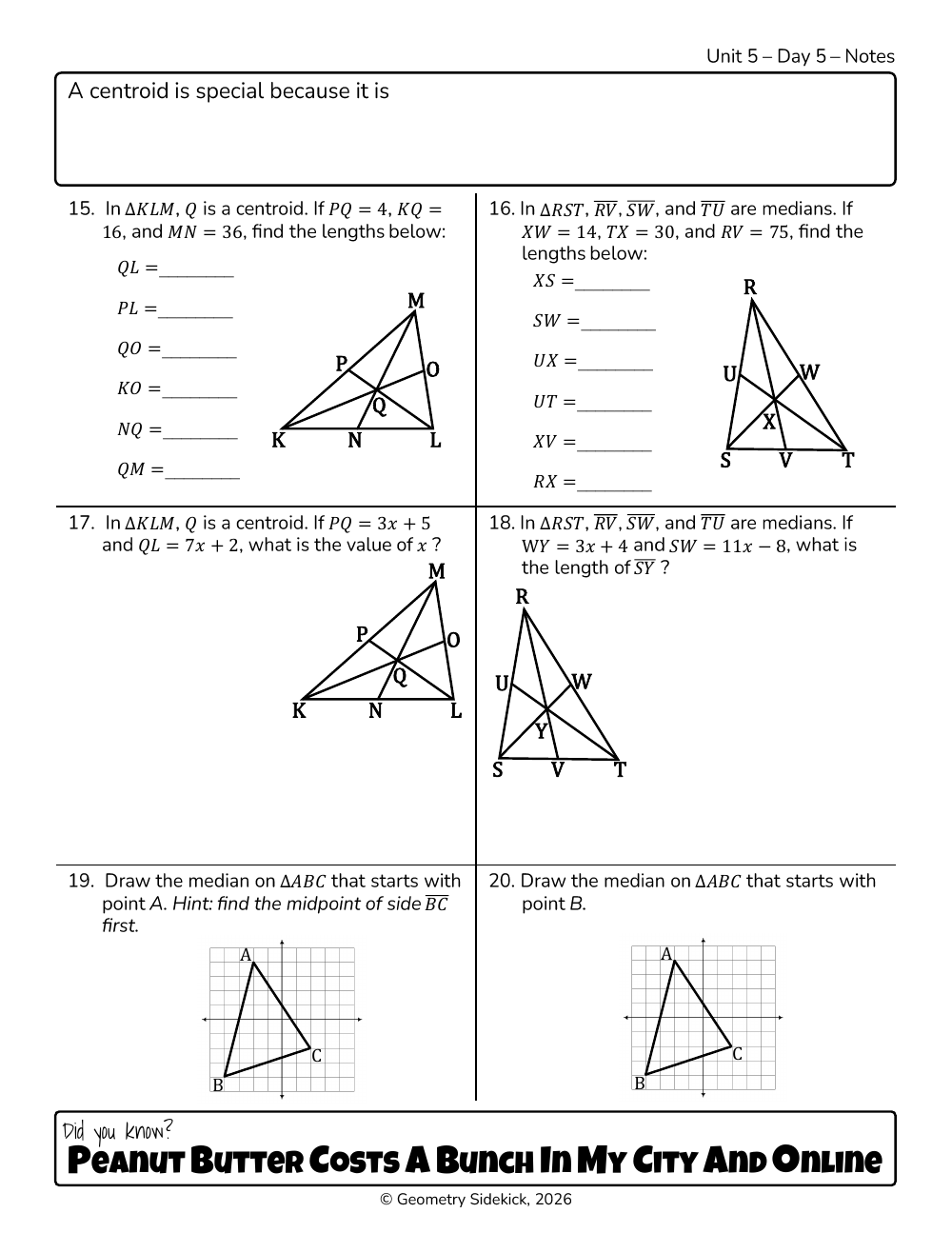
That's what we do in this lesson. Instead of starting with the fractions, we give students a triangle with all three medians drawn and each segment labeled. Then we ask them to look for a pattern (Problem 6). From there, they write the relationship themselves: two times the piece from the centroid to the midpoint equals the piece from the centroid to the vertex.
It's a small difference in how we teach the concept, but students who find the pattern themselves don't have to remember which fraction goes where. They can look at the drawing and figure out whether they need to double or halve.
The lesson at a glance
- Course: High School Geometry - Unit 5, Day 5
- Common Core Standard: HSG-CO.C.10: prove theorems about triangles, including that the medians of a triangle meet at a point
- You need:
- Guided notes (2 pages)
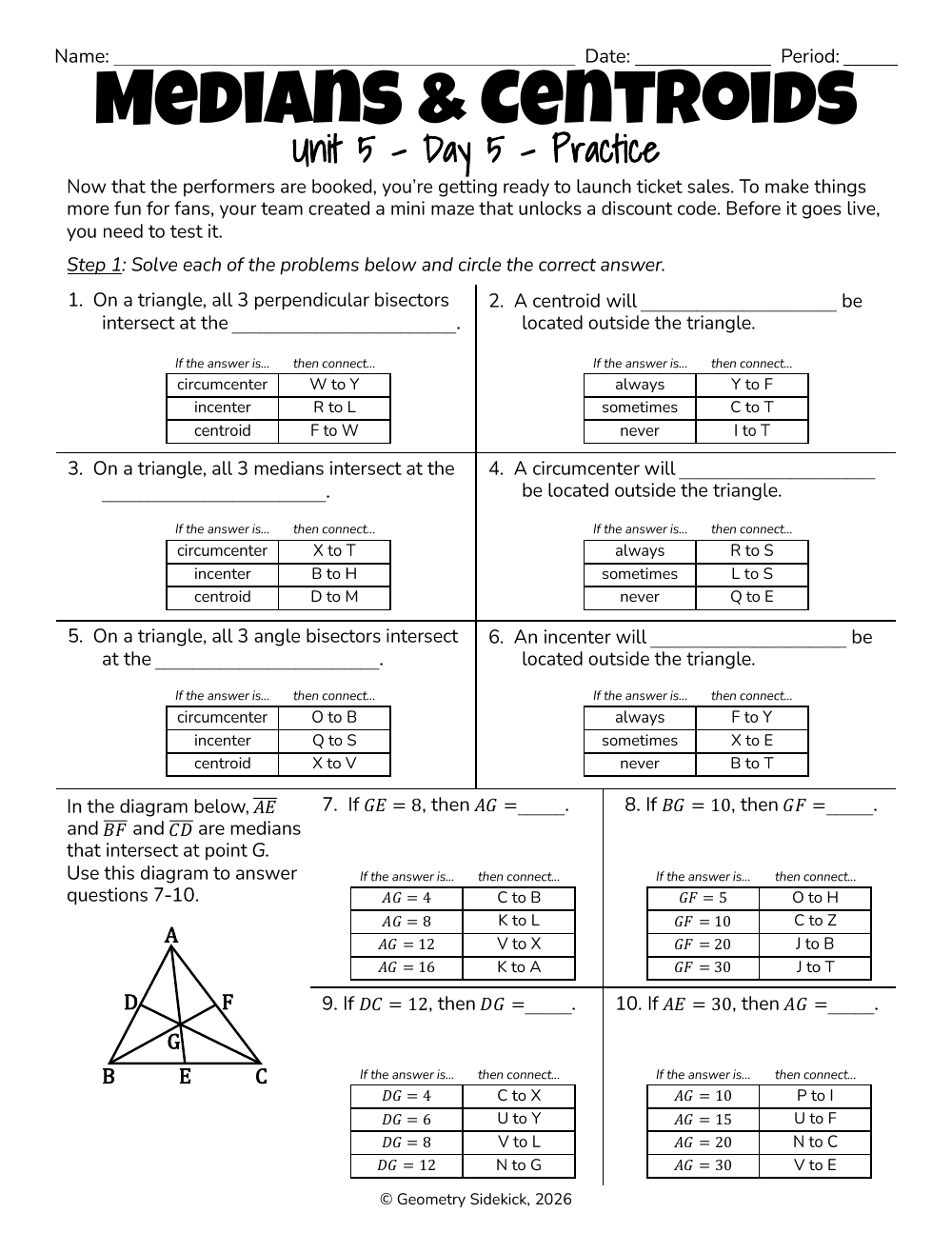
- Practice activity (2 pages)
- Ruler or straightedge for drawing medians and maze lines
- Skills to refresh first:
- Solving linear equations with distribution
- SWBAT:
- describe a median as a segment connecting the midpoint of a side of a triangle to the opposite vertex and identify the centroid as the point where all three medians intersect.
- apply the centroid's ratio relationship (the distance from the centroid to the vertex is twice the distance from the centroid to the midpoint) to solve numerical and algebraic problems.
- determine that the centroid is located inside all triangles.
- draw medians on coordinate grids.
Here are 4 habits that make it stick for your students:
- Determine the segment you know and the segment you need.
Students can usually tell which segment is shorter just by looking at the drawing. Before they start calculating, have them figure out which segment they are given (the shorter, the longer, or the whole median) and which segment they need to find.
A lot of the mistakes in this lesson happen because students skip that step and go straight to the numbers.
- Skip the fractions.
Instead of using fractions, ask students to think about doubling and halving.
- Given the short piece? Double it to find the long piece.
- Given the long piece? Divide by two to find the short piece.
- Given the whole median? Divide by three to find the short piece, then double to find the longer piece. Or find the number that, when added to its double, equals the whole median.
- Keep mixing in the other triangle centers.
By this lesson, students have learned about the circumcenter and incenter and they can start mixing up which special segments create each center.
That's why the practice activity intentionally mixes circumcenter and incenter questions with the centroid problems. Students have to remember which segments intersect to create each center instead of just working through a page of centroid problems.
- Help your students remember which center goes with which special segment.
There's also a mnemonic at the bottom of the guided notes:
Peanut Butter Costs A Bunch In My City And Online
It represents:
- Perpendicular Bisectors → Circumcenter
- Angle Bisectors → Incenter
- Medians → Centroid
- Altitudes → Orthocenter
Students learn about altitudes and the orthocenter in tomorrow's lesson, so the mnemonic device also gives them a preview of what's coming next.
Unit 5, Day 5: Medians and Centroids
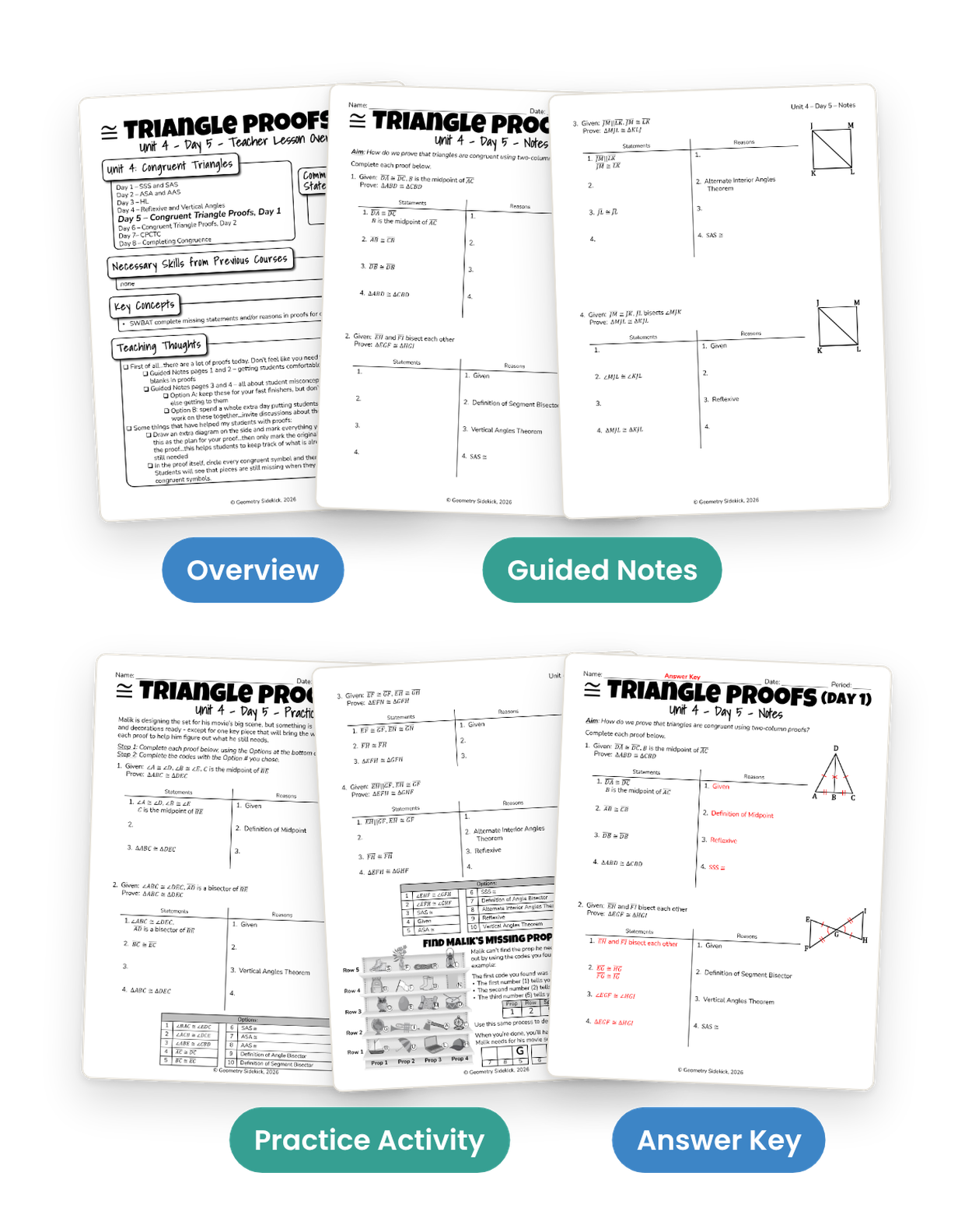
This lesson includes guided notes and a reveal maze practice activity.
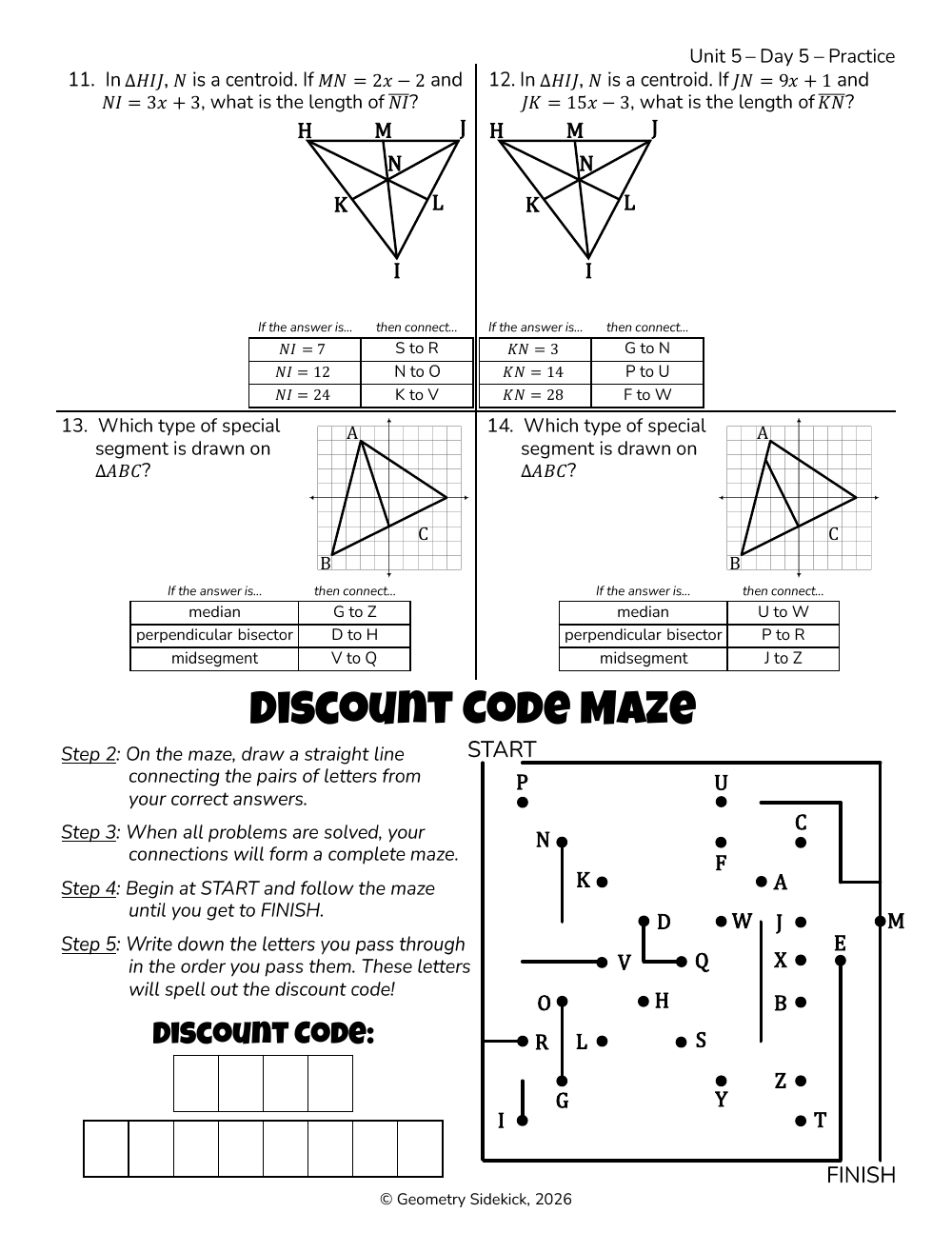
Like every practice activity in the Geometry Sidekick curriculum, the maze is self-checking. Each correct answer tells students which two letters to connect, and those connections create the walls of the maze. Once they've answered all the questions, they follow the maze from START to FINISH to find the discount code. If they've answered everything correctly, the code will make sense. If not, they'll know they need to go back and check their answers.
Students can discover on their own whether they're correct. No waiting for you to check their work, and no answer key needed just to see if they got it right.
The files
We are teachers, your email is safe with us. Unsubscribe anytime.
This lesson is from our Unit 5 (Relationships in Triangles)
- 5.01 Midsegments
- 5.02 Perpendicular Bisectors
- 5.03 Angle Bisectors
- 5.04 Circumcenters and Incenters
- 5.05 Medians and Centroids
- 5.06 Altitudes and Orthocenters
- 5.07 Triangle Segments on Graphs
- 5.08 Triangle Centers on Graphs
- 5.09 Triangle Inequalities
See every unit in the membership
THE MEMBERSHIP
Want every Geometry lesson, ready to teach?
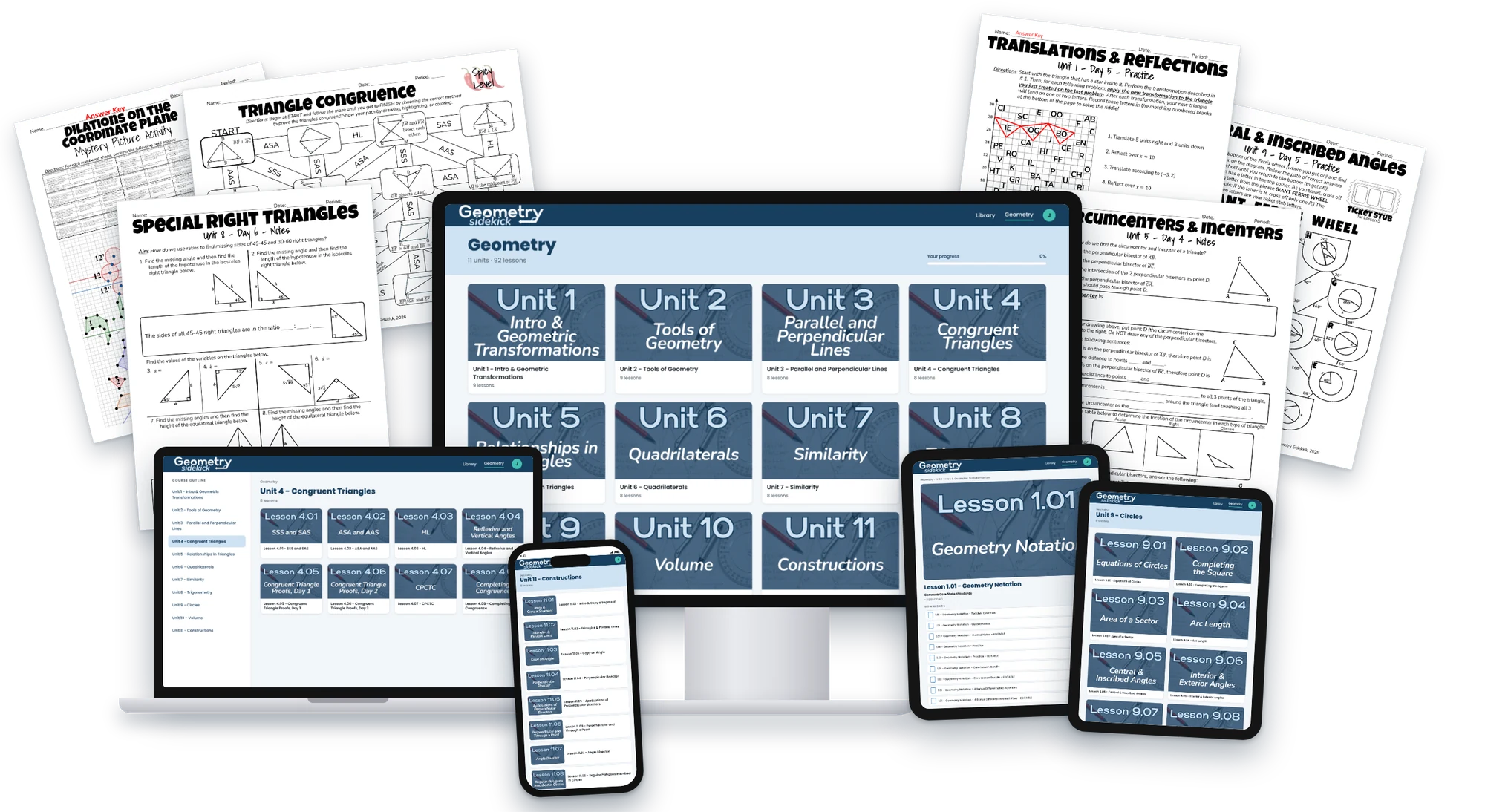
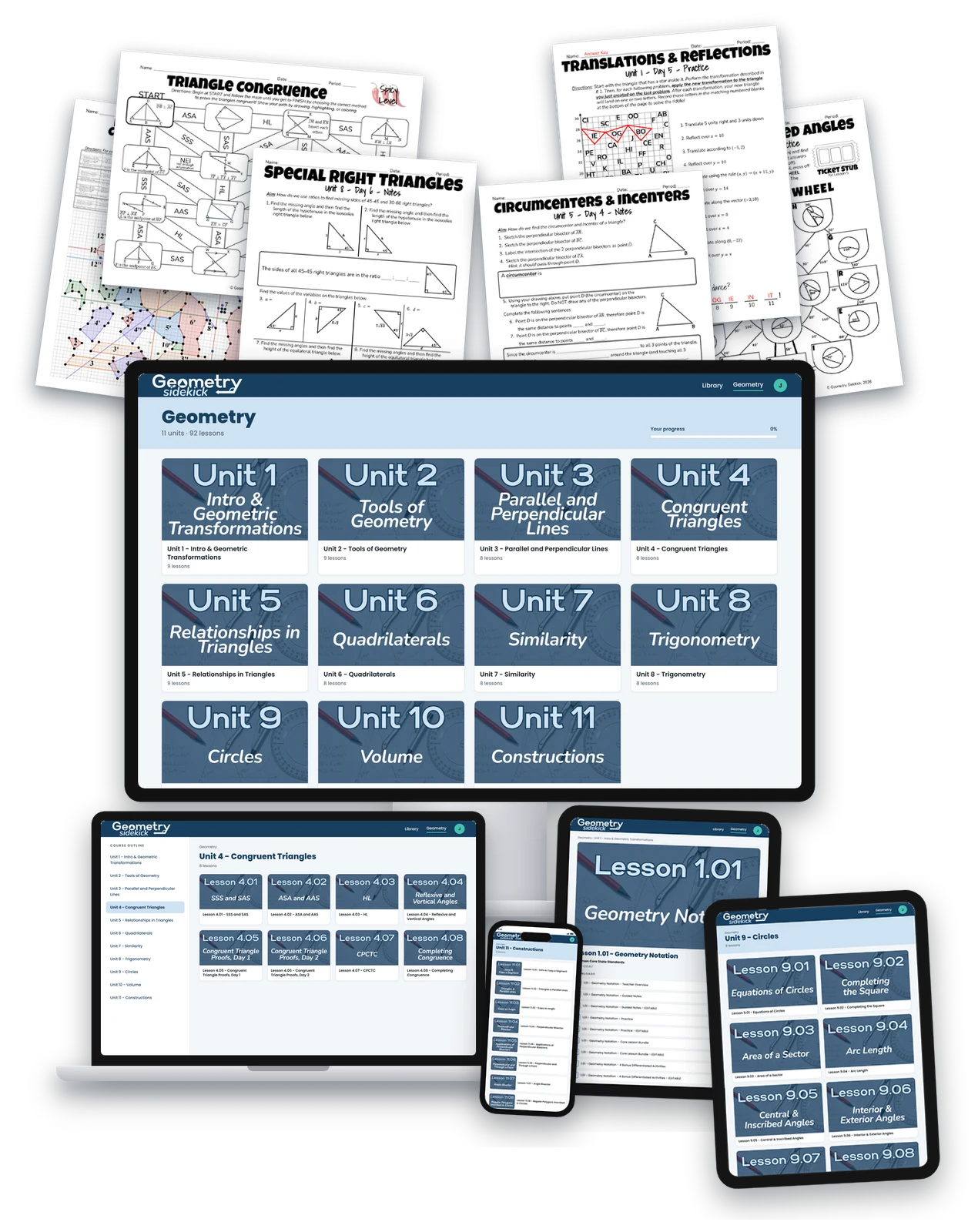
All 11 units with 92 total lessons, each with a teacher overview, guided notes, a practice activity and a fully worked answer key. Available as a PDF or an editable PowerPoint. Members also get access to bonus differentiated activities for selected lessons across the curriculum. Open the lesson you need tomorrow, print it, teach it.
Join Membership